
By tonight, rain over eastern Missouri is expected to turn into wet snow, and roughly 81.5 million Americans are still counting on being somewhere else by Thursday dinner.
That tension sits at the center of thanksgiving 2026. The turkey is the easy part. The hard part is a pair of storms, one on each coast, that have no interest in your reservation or your cousin’s flight out of Charlotte.
AAA expects 81.5 million people to travel at least 50 miles between Nov. 24 and Nov. 30, a hair below last year’s 81.6 million. The headcount barely moved. The weather around it moved a lot, and that is the part worth reading before you leave the house.
81.5 Million Travelers and a Map That Won’t Cooperate
Start with the crowd. AAA says nearly nine in ten holiday travelers will drive, which works out to 72.9 million people on the road, slightly fewer than the 73.1 million who drove last year. Another 5.96 million will fly domestically, and 2.6 million more will take a bus, train or cruise, a group that grew 4.1%.
Money explains part of the dip. AAA points to higher travel costs: round-trip domestic fares are up 17%, averaging about $800 a ticket, and gasoline could top the previous Thanksgiving Day record of $3.58 set in 2022.
Cost is something you can plan around. Weather is not.
The Weather Channel’s team lays out the whole run in its day-by-day Thanksgiving travel weather forecast covering storms across the US, and what follows is the short version.
Wednesday Through Sunday: The Storm, Day by Day
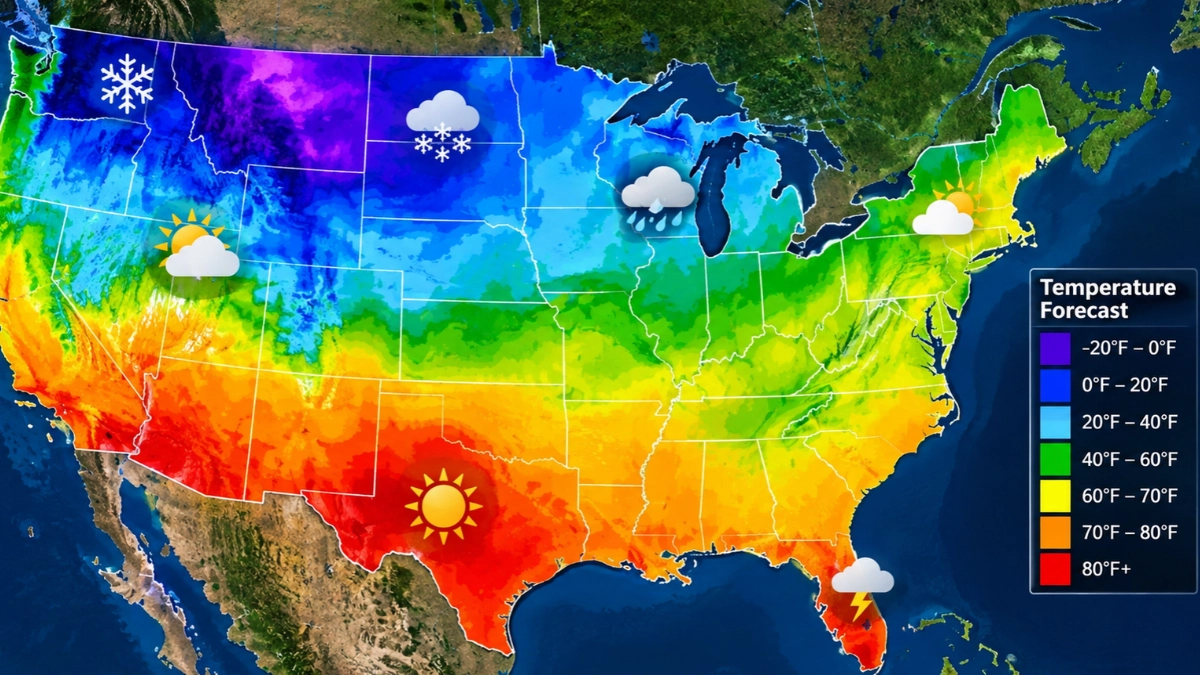
A usa map of this week tells a lopsided story: trouble on both edges, a messy stripe through the middle, and one calm pocket on Saturday.
Wednesday: rain in the South, slush in the Midwest
Heavy rain is soaking the Southeast, from Florida through Georgia, the Carolinas, Alabama, Mississippi and Tennessee. Flight delays are possible in Atlanta, Charlotte, Orlando and Miami.
By tonight the rain pushes into the mid-Atlantic and Ohio Valley, while parts of eastern Missouri, western Illinois and southeast Iowa switch to wet snow. The St. Louis area could see slushy, locally heavy accumulation on roads. Out west, another surge of moisture is hitting western Washington and northwestern Oregon.
Thursday: the day that matters
The eastern storm keeps climbing through the Northeast, the Ohio Valley and the eastern Great Lakes, with heavy rain and strong gusts. In the interior of northern New England, precipitation may begin as freezing rain, which means icy bridges and overpasses.
Forecasters expect significant flight delays at every Northeast hub airport, plus St. Louis because of the snow. O’Hare, Pittsburgh, Cincinnati, Detroit and Seattle could also run into trouble. Wet snow lingers from Missouri into Tennessee, and the Pacific Northwest keeps collecting rain and mountain snow that drifts toward Idaho and western Montana.
Friday: the leftovers
Wind, rain and a bit of wet snow can still slow travel across the Northeast and Ohio Valley. The northern Rockies pick up fresh snow.
Saturday: the window
Saturday looks like the best travel day of the stretch for most people. Showers and mountain snow hang around in the far north and in the northern and central Rockies, but the big disruption fades.
Sunday: round two
The return trip gets messy again. Showers and a few thunderstorms ahead of a cold front soak the South and Midwest, and O’Hare could see delays. A new Pacific system brings rain and mountain snow to Northern California and the Pacific Northwest, which may slow departures from San Francisco.
The Wind Problem Nobody Packs For
Rain gets the headlines. Wind does the quiet damage. Strong gusts come along with Thursday’s eastern storm, and gusts matter more than most travelers think: they shove tall vehicles across lanes, slow takeoffs and landings, and drop tree limbs onto power lines.
A high wind warning is the National Weather Service’s way of saying the gusts are serious. The usual thresholds are sustained winds of 40 mph or more for an hour or longer, or gusts of 58 mph or higher, though local offices adjust those numbers. If your county lands under one, treat it as a reason to rethink a long drive in a pickup, an RV or anything pulling a trailer.
Then there is New York. City rules keep the giant Macy’s parade balloons grounded when sustained winds pass 23 mph or gusts top 34 mph. With a storm climbing the coast on Thursday, the wind readings are worth a look if you plan to stand on a curb at dawn.
Why One Delayed Plane Wrecks Everyone’s Day
Here is the part airlines rarely explain at the gate. Your flight can leave a sunny airport and still run late, because the plane or the crew is arriving from a city under a storm. Fox Weather’s analysis makes the same point: clear skies where you depart do not protect you.
The history backs it up. Between January and September 2026, Chicago O’Hare logged more than 18,200 weather-related disruptions, the most of any major airport in that comparison. Boston Logan had nearly 9,600, which made up 61% of all its delays, and LaGuardia reported about 9,200.
So when forecasters call Thursday rough for the Northeast hubs, the ripple does not stop at the Hudson.
The Playbook: Beat the Storm Instead of Racing It
You cannot out-drive a front, but you can out-schedule one. The forecast hands you a gift, and it is called Saturday.
Rule of thumb: if Thursday is optional, make it Saturday.
If your plans are flexible, that is the day to move. Leaving Thursday through the Northeast corridor means betting on slick roads and crowded terminals. Leaving Saturday means a calmer run, with the same leftovers waiting at the other end.
If you have to go sooner, a few habits help:
- Fly early. Delays pile up as the day goes on, so the first flight out has the fewest chances to get caught.
- Check your airline app. Carriers often allow free rebooking when a storm is on the way, but only if you ask before the chaos starts.
- Pack for the road you might get. An ice scraper, a blanket, water, a phone charger and a full tank cost almost nothing.
- Look again before you leave. Check the thanksgiving storm weather forecast one more time, because storm timing shifts by the hour.
Weather at least has the decency to send a warning. Some disruptions do not, and our report on the earthquake in Los Angeles is a blunt reminder that a trip can fall apart with no forecast at all. Keep a plan B for everything.
Thanksgiving Travel Weather: Your Questions Answered
Will storms delay flights on Thanksgiving Day?
In some places, yes. Forecasters expect significant delays at all Northeast hub airports and in St. Louis, where snow is the issue. Delays are also possible at O’Hare, Pittsburgh, Cincinnati, Detroit and Seattle.
Where will it snow on Thanksgiving Day?
Wet snow should continue from Missouri into Tennessee, with slushy roads likely in Missouri and Illinois. Mountain snow continues across Washington, Oregon, Idaho and western Montana. Interior northern New England could see freezing rain first.
What is the best day to travel after the holiday?
Saturday looks like the best bet. Friday still carries wind and rain in the Northeast and Ohio Valley, and Sunday brings showers, thunderstorms and possible delays at O’Hare and San Francisco.
What is a high wind warning, and should I still drive?
It is a National Weather Service alert for dangerous winds, typically sustained 40 mph or more for an hour or longer, or gusts of 58 mph or higher. Driving is possible but risky, especially in tall vehicles. If you go, slow down, keep both hands on the wheel and consider delaying.
Is thanksgiving 2026 travel at a record level?
Not quite. AAA projects 81.5 million travelers, about 0.1% below last year’s 81.6 million, which ends a three-year run of records. Volumes remain close to record levels, so expect full roads and packed terminals.
Where This Leaves You
The storms will come and go. By Saturday, most of this will be a story you tell at the next family dinner, probably with the delayed-flight details exaggerated a little.
Between now and then, the smart move is a boring one: leave earlier than you think you need to, keep your route flexible, and stash some patience in the glove box. The weather will not bend to your schedule, but your schedule can bend to the weather.
More stories from USA News.