
At 3:25 a.m. on Friday, November 20, the ground under eastern Los Angeles gave one short, sharp shove, and thousands of people were reaching for their phones before they were fully awake. By a seismologist’s standards it was a modest event. By the standards of a region that still talks about Northridge, it was a free drill nobody signed up for.
If you are trying to make sense of the earthquake los angeles felt before dawn, here is the short version. The USGS measured it at magnitude 4.2. Officials reported no injuries, no damage and no disruption at LAX. Anyone who typed los angeles earthquake today into a search bar over breakfast was probably after exactly that reassurance. The longer version is more interesting, and more useful.
In This Story
- The Shake, in Plain Numbers
- A Number That Changed Twice
- Why a 4.2 Felt Bigger Than It Was
- Two Quakes, One Night
- The Fault Line Under the City
- The City Checks Itself
- What to Do Before the Next One
- Frequently Asked Questions
- The Cheapest Warning California Gets
The Shake, in Plain Numbers
The USGS placed the epicenter about a mile northwest of Commerce, a small industrial city a short drive east of downtown, at a depth close to 10 miles. More than 12,000 people filed reports on the agency’s “Did You Feel It?” page within hours. Alhambra, San Gabriel, Pasadena and Long Beach all felt it. So did North Hollywood and Calabasas, on the far side of the basin.
Some of the reach was stranger. One outlet counted reports stretching from Oxnard to Oceanside, more than 100 miles apart, and seismographs registered the shaking in Anaheim and San Bernardino.
The National Tsunami Warning Center saw no tsunami threat. California’s Office of Emergency Services said it was coordinating with county officials, with no damage reported as of Friday morning.
A Number That Changed Twice
The first estimate was 4.2. Then the USGS raised it to 4.4. Then it dropped back to 4.2. NBC’s report on the magnitude 4.2 earthquake that shook Los Angeles County early Friday tracks the back-and-forth, and it is a handy reminder of how the process works. Automated systems throw out a fast estimate within minutes, and analysts tighten it as more seismograph data arrives.
So if you saw 4.4 on your phone and 4.2 on the morning news, nobody made a mistake. You caught the math mid-correction.
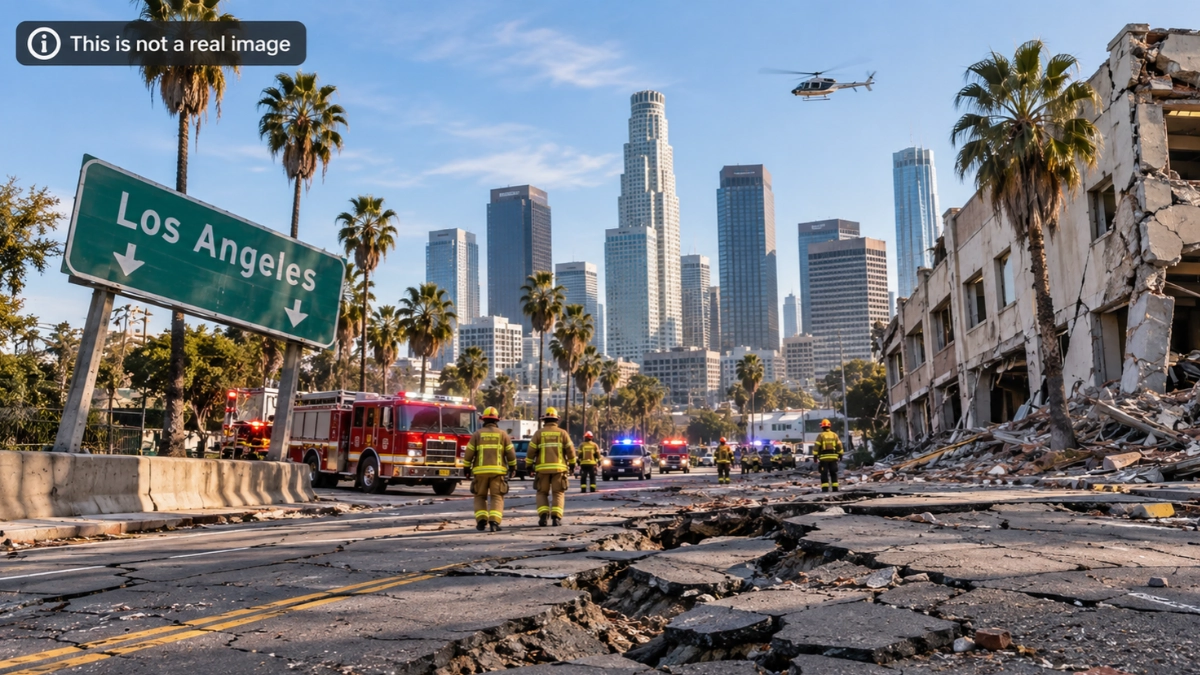
Scale matters more than the decimal anyway. Every full step up the magnitude scale means roughly 32 times more energy. Northridge in 1994 was a magnitude 6.7 and brought down freeway overpasses. It released thousands of times more energy than Friday’s quake. Same region, different universe.
Why a 4.2 Felt Bigger Than It Was
The epicenter sat under one of the most crowded counties in the country, home to roughly 10 million people. A moderate quake under open desert gives a few ranchers a story. The same quake under a dense metro wakes thousands, and Friday’s did.
The ground adds its own twist. Much of the LA basin is a deep bowl of soft sediment, and soft sediment tends to amplify shaking and drag it out compared with hard rock.
Then there is the hour. At 3:25 a.m. almost everyone is lying down in a quiet room, the ideal setup for noticing a shake that would pass unnoticed at midday.
That helps explain why the la earthquake dominated Friday’s news. Southern California records thousands of small quakes every year, and most pass without a single headline. Location and timing decide which ones don’t.
Two Quakes, One Night
Los Angeles was not the only part of California losing sleep. Late Thursday, a quake of about magnitude 5 hit near Pinnacles National Park in San Benito County, roughly 240 miles up the state. Early reports disagreed on the exact size, with 5.0 and 5.1 both in circulation.
The USGS flagged it as a potential mainshock, followed by dozens of smaller quakes. It put the chance of another magnitude 5 or larger nearby at 2% for the coming week.
Two quakes less than five hours apart invites a theory. The reports available Friday did not tie them together, and with that much distance between them, coincidence is the default assumption. California has thousands of faults. Sometimes two of them just happen to be busy on the same night.
The Fault Line Under the City
The Los Angeles region sits above the Puente Hills fault system, a network of buried thrust faults running beneath downtown and the neighborhoods east of it. Buried is the key word. These faults do not break the surface in a tidy line you can walk along. Scientists found them largely through oil-industry seismic data and the aftershocks of the 1987 Whittier Narrows earthquake.
Whittier Narrows was a magnitude 5.9 and killed eight people in the same part of the county. It is the reason Puente Hills is taken seriously.
The USGS has not said which fault produced Friday’s quake, and the coverage available so far does not either. Until seismologists finish their analysis, pinning it on Puente Hills would be a guess.
The City Checks Itself
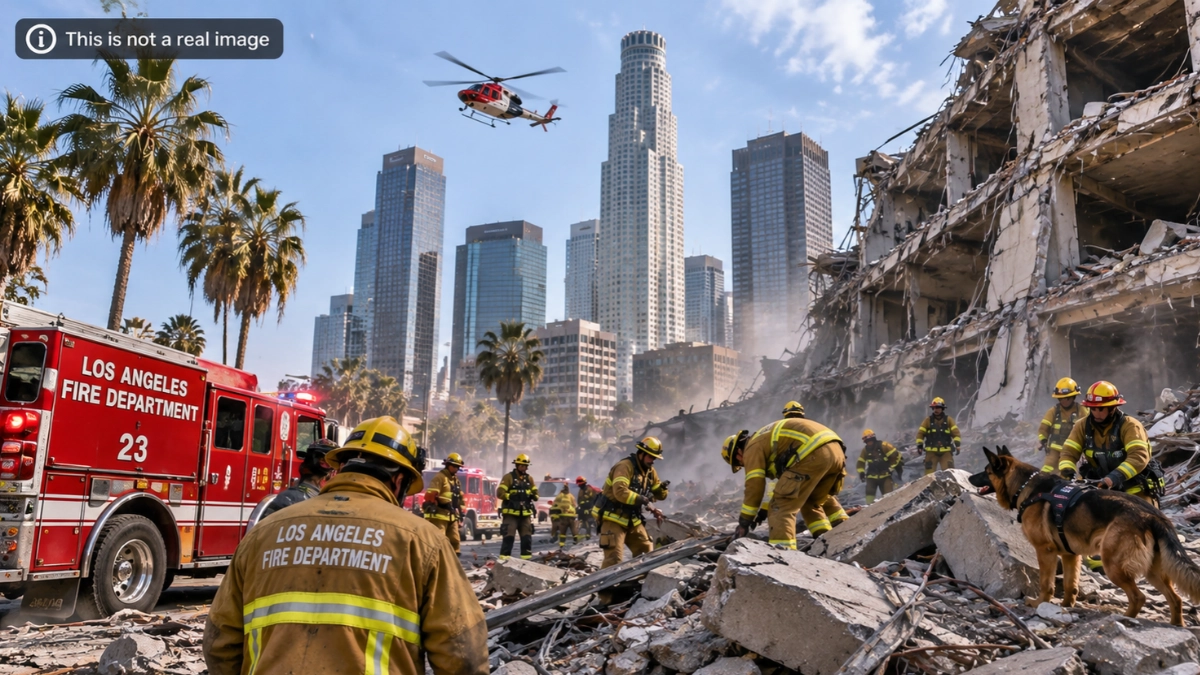
Within hours the Los Angeles Fire Department switched to its earthquake response procedures and sent crews from all 106 neighborhood fire stations to check critical infrastructure. Mayor Karen Bass said on X that the quake was unsettling but that there were no immediate reports of damage or operational problems, LAX included.
The USGS issued a green PAGER alert, its lowest tier, which signals a low likelihood of casualties or damage.
Aftershocks are possible but unlikely to be dramatic. According to the USGS forecast cited in local reporting, there is a 27% chance of at least one magnitude 3 or larger aftershock over the next week, 4% for magnitude 4 or larger, and less than 1% for magnitude 5 or larger.
What to Do Before the Next One
Most people’s first move after a quake is to grab a phone and type earthquake near me. That works, but wait for the shaking to stop. While it lasts, the job is simple: drop to the floor, cover your head and neck under a sturdy table, and hold on. In bed, stay there and protect your head with a pillow.
Skip the doorway, because modern guidance dropped that advice. Skip the dash outside too, since falling glass and debris are what hurt people there.
Afterward, the checklist is short:
- Check for gas smells, broken glass and cracks in walls or chimneys.
- Text instead of calling, so phone lines stay open for emergencies.
- Report what you felt at earthquake.usgs.gov. Those reports help scientists map how far the shaking carried.
Then comes the dull but valuable homework. Keep water for several days, at least a gallon per person per day. Strap down tall furniture and water heaters. Read your insurance policy, because standard homeowners coverage in California generally excludes earthquake damage, and covering it usually means a separate policy.
Money is usually the second thing people think about after safety. If your mind drifted to your portfolio on Friday morning, our ant stock price page is a handy place to start.
Frequently Asked Questions
How strong was the Los Angeles earthquake on Friday?
The USGS measured it at magnitude 4.2 after briefly listing it as 4.4. It struck at 3:25 a.m. about a mile northwest of Commerce, at a depth near 10 miles, and produced light shaking across the region.
Was anyone hurt, or was there any damage?
As of Friday morning, authorities reported no injuries, no damage and no disruption at LAX. Fire crews from all 106 neighborhood stations inspected critical infrastructure.
Will there be aftershocks?
Possibly small ones. The USGS forecast gives a 27% chance of a magnitude 3 or larger aftershock this week, 4% for magnitude 4 or larger, and under 1% for magnitude 5 or larger.
Was this the Big One?
No. That nickname usually refers to a major rupture on the San Andreas Fault, often magnitude 7 or higher. A 4.2 releases a tiny fraction of that energy, and small quakes do not relieve enough stress to prevent a larger one.
Where can I check updates and report that I felt it?
The USGS earthquake site, earthquake.usgs.gov, posts magnitudes, maps and aftershock forecasts, and it takes “Did You Feel It?” reports. The MyShake app delivers earthquake alerts in California.
The Cheapest Warning California Gets
Friday’s quake did what small quakes do best. It hurt nobody, broke next to nothing, and reminded millions of people that the ground here is not a promise. The same busy fault network that produced a 4.2 is capable of far worse, and nobody can say when.
That is the useful part. A quake without casualties is a rehearsal with real stakes. Did you wake up? Did your phone buzz? Did you know where the flashlight was? Fix whatever failed this week, while the memory is fresh.
Seismologists will keep refining the numbers as the USGS finishes its analysis. The checklist above takes an afternoon. Do that part now.
For more coverage like this, browse our USA News category.